Today's Book Group Spotlight intrigues me because it's a group that not only revolves around a particular theme, but it is also an offshoot of the programming at a cultural institution. The Arts and Culture Book Club meets on the fourth Tuesday of the month (September through June) in the upstairs art gallery of the Walters Cultural Arts Center in Hillsboro, Oregon.
Beth Stout, who works for the Arts Center, wrote in to tell us about the group:
We got started because the Arts Center offers a free event every Tuesday of the month. On First Tuesday we celebrate our art gallery opening. On Second Tuesday we have Open Poetry Night and on Third Tuesday we have our Spoken Word Lecture Series. In looking for something related to our mission, an Arts & Culture Book Club seemed like a good fit. So I spread the word via e-mail, web and news releases and we attracted 12 people to get the club started.
We read books – mostly non-fiction but one or two novels – related to the arts. Our 2009 book list included a biography of Diego Rivera; a history of the Faberge’ Eggs; a biography of Louis Armstrong and the novel, Luncheon of the Boating Party. We also read Jonathan Lopez’, The Man Who Made Vermeers. That, along with Faberge’s Eggs by Toby Faber probably drew the most discussion.
Our book list for 2010 is already selected. We have most of the same group returning after the summer. Two participants reluctantly dropped out due to time conflicts – we meet from 6-7:30pm. But we gained 3 new members over the summer, so our group will be a little bit bigger. Our group is largely women, but we do have two men. It’s an enthusiastic group and our discussions are lively and reflect a depth of knowledge about background material because many of our members are artists themselves – which is fun.
I think the idea of a book group within a museum or arts organization is an idea that should be more widespread. If you know of any others, please tell us in the comments. And if you work with an arts organization in your area, please consider hosting a book group of your own. I know that if there were such a group near me, I'd be sure to join!
Thanks so much, Beth, for telling us about your group and for sharing your group's photos -- and for hopefully inspiring others to start something similar!
Ann mentioned in the comments section of today's podcast show notes that she just started listening to the audio of Barbara Kingsolver's Animal, Vegetable, Miracle, and the she is really enjoying it. I too loved that book. Another book on the same topic (and one that Kingsolver references in her book) is Plenty by Alisa Smith and J.B. MacKinnon. Like Kingsolver and her family, Alisa and J.B. vow to eat a "100-mile-diet" for one year, but they do it without the relative luxury of living on a farm and growing their own food. I originally spoke about the book in episode 8 of the podcast, so check that out if you'd like to hear more.
In a nice bit of serendipity, I just found out yesterday that Alisa and J.B. created a show for Canadian television and it has just started airing on Planet Green here in the U.S. The show, called The 100-Mile Challenge, started last week, so I've already missed an episode, but I've got the rest set to tape on my DVR and can't wait to watch!
___________________
We encourage you to write down or print out the title information and shop at your local bookstore. Titles link to LibraryThing, a social networking site that allows you to catalog your home library. LibraryThing also links to various online purchasing options. Here are the books from this post: Animal, Vegetable, Miracle by Barbara Kingsolver, Harper Perennial trade paperback Plenty by Alisa Smith and J.B. MacKinnon, Three Rivers Press trade paperback
It's awards season! The National Book Awards finalists were announced this past week, and we are thrilled that two books we've spoken about previously, Let The Great World Spin by Colum McCann, and Stitches by David Small, were both on the shortlist.
The Man Booker Prize was also recently awarded to Wolf Hall by Hilary Mantel. Ann was rooting for one of the shortlisted titles, The Children's Book by A.S. Byatt, which she spoke about in podcast #46.
The full list of the National Books Awards finalists can be found here, and the list of the Man Booker Prize shortlisted titles are here.
In segment 2, Ann marks the end of Farmer's Market season by reading a few books about the importance of eating locally and sustainably. Michael Pollan's In Defense of Food looks at the current obsession with "nutritionism" in the United States. Pollan's manifesto can be boiled down to a simple statement: "Eat food. Mostly plants. Not too much." Next on Ann's reading list is Pollan's The Omnivore's Dilemma.
Michael recently blogged about Food Matters by Mark Bittman, which is similar in focus to In Defense of Food, but also contains recipes. Kitchen Express is Bittman's newest cookbook, which is organized seasonally and is written in a manner that allows the home cook to experiment and put their own twist on the recipes.
Judith Jones' The Pleasures of Cooking for One is a book that Ann has been savoring for the last few weeks. Judith believes that everyone should treat yourself to a pleasurable meal, even if you eat alone. In her book, she tells you how to shop and plan your meals so that you can take advantage of market offerings but not eat the same dish for an entire week. This book reminds Michael of Alice Waters' The Art of Simple Food, which is also one of Ann's favorites.
In segment 3, Michael talks about John Irving's Last Night in Twisted River. This is a novel spanning 50 years, and begins with the accidental shooting of a local constable's girlfriend, who a young boy mistakes for a bear. Danny, the boy, and his father Dominic, go on the run, traveling through America and Canada in vintage John Irving fashion. John Irving has written a short piece about the writing of the novel, and has created a video talking about it, on the official John Irving website.
Ann talks about The Glass Room by Simon Mawer, which is published by Other Press and was shortlisted for The Man Booker prize. Set in 1930s Czechoslovokia, it's the story of a well-to-do couple who hire an architect to build their home. The home becomes the center of the novel, with its massive windows and wall of onyx acting as the mechanism for telling the story of the family and the history of the time. It should be in stores by the time you read this.
(You can listen to the podcast by using the player at the top of this post. If you're using Internet Explorer, click twice to listen. If your browser does not support javascript, you won't see the player; click the link below the player to listen, or right-click to download the episode. If you are receiving this post by email and cannot see the player at the bottom of the message, please visit http://www.booksonthenightstand.com to listen)
___________________
We encourage you to write down or print out the title information and shop at your local bookstore. Titles link to LibraryThing, a social networking site that allows you to catalog your home library. LibraryThing also links to various online purchasing options. Here are the books from this post:
In honor of National Reading Group Month, we asked Books on the Nightstand readers and listeners to tell us a bit about their reading groups. Caroline Rose wrote in to tell us about her group. As the mother of a second-grader and a fifth-grader myself, I immediately wished that I had a Caroline in our life. Thank you, Caroline, for sharing your incredible work with us!
Caroline says:
I'm a former upper-elementary/middle-school social studies teacher in Lousiana, former because I've decided to focus on writing full time. I couldn't walk away completely, though. I feel too strongly about promoting books and I wanted to continue my relationships with my students. Having started a historical fiction book club with my older students last year, my fabulous principal has let me design my own after-school program, extending down to third grade.
I meet with third grade by themselves and have paired fourth with fifth and sixth with seventh. The third graders are moving into chapter books and mid-grade novels for the first time, and I wanted to share things I loved as a girl -- Ramona, The Boxcar Children-- as well as new classics, such as Sarah, Plain and Tall, and The Whipping Boy.
The fourth and fifth grade will focus on historical fiction, old and new, from Pedro's Journal (a story about travels with Columbus) to Karen Cushman's '49er novel, The Ballad of Lucy Whipple.
Kids need to see adults excited about literature! They need someone reading alongside, learning what topics interest them, suggesting titles, thinking through storylines/settings/characters with them. I have come to know my students in a deeper way through this process. Kids are born readers and need the place to experience story with others.
Caroline, I couldn't agree more about the importance of adult reading in the life of a child. Thank you so much for telling us about your group. In fact, I'm going to grab a copy of The Bronze Bow for my fifth-grader; she's very interested in the ancient world, and Elizabeth George Speare was a favorite author of mine when I was that age. Thanks for the recommendation!
If you've ever blogged, you know that it can sometimes feel like a lot of work. I confess that there are many times when I'd rather be reading a book then blogging about reading a book. But then, every so often, I am reminded of the incredible community that has sprung up here, and I realize that I get so much from your participation that it could never really be just "work".
I had an experience like that just recently. It happened in the comments of Josh Christie's post Bring on the Tears. Tanya's comments, and subsequent expansion on those comments, were so powerful that I had to pull them out and give them their own space.
In his post, Josh asked, "What book made you cry?". Tanya, who works for an audiobook publisher, answered:
This year I read WAITING FOR COLUMBUS (by Thomas Trofimuk) which had such a powerful denouement that I broke down, as did my husband who narrated it (in fact, you can hear him break down on the recording. He wanted to go back and "fix" it, but it was such an honest reading that when he tried to "pull back" it ended up sounded fake! So, the original reading stands...)
I feel like I've known Tanya for a long time, thanks to her interaction with us here at Books on the Nightstand, but I had no idea that her husband was an audiobook narrator, and had no inkling that he narrated this book that I loved so much. Of course, I needed to know more, so I asked Tanya to tell us the whole story. Here it is:
"Last April you mentioned WAITING FOR COLUMBUS in a blog/podcast. That's all you did, mention it, but for some reason I became obsessed with it. I literally couldn't wait until August to read the book, but I had no way to legitimately, personally, request an Advance Reading Copy from the publisher, so... I asked my boss to look into getting a galley. I was shocked when he came back and told me that our company had acquired the audiobook rights for the book!
The manuscript came to Blackstone and I was so excited, but I was soon thwarted in my attempts to pre-read it! My husband, Grover Gardner, who is the studio director for the company, always vets the galleys in order to make casting choices. He got the first crack at Waiting For Columbus and after reading the first chapter, insisted that he himself was going to narrate! He pre-read the whole of the book and finished right before dinner one night. Fork midway between plate and mouth, he stopped, started crying and left the table. He walked the dog for an hour and a half. All because of Waiting For Columbus. Of all the books he has narrated, this had never happened before. When he came back from his "time-out" I suspiciously queried him as to whether the book was that maudlin. He shook his head and only said "You'll see."
I insisted on being the recording engineer for the book. We were in the booth. The first "land mine" hit and I was affected, but okay. The second land mine hit and I could barely hold it together. Grover, even though he had already read the book, fell apart again. It is not maudlin, but beautifully and powerfully written. The book has become a very personal experience for each of us and both of us.
Even now, months after we cut the master, I can quote certain passages and there is one passage in particular which still sends me into a paroxysm of emotion. The book had another impact on me in a much more general way: I now search out books written by poet-novelists. I've come to appreciate Ondaatje's and Margaret Atwater's word crafting in particular, but it was Thomas Trofimuk's words that found their way to my heart first.
Anyway, that's probably way more than you wanted to know, but there it is.
For those who may be interested in the audiobook, you can listen to a sample at the Blackstone Audiobooks page for the title.
Tanya, thank you so very much for sharing your story. It's amazing, and moving, and I can't wait to listen to the audio with your and Grover's experience in mind.
I'm back from my short BOTNS family leave (though, since we prerecorded a few episodes, it's like I was never away!). Finn is two weeks old and very cute, but he's seriously cutting into my reading time... these days, I'd rather just stare at him!
A quick reminder to please call our voice mail line with your story of a book you loved that you heard about here on Books on the Nightstand. We'd love to include several of these in our 50th podcast episode. Please call in by Wednesday, October 21st, so we'll have time to put the episode together for 10/28.
Over at our Goodreads group, Stephanie started a discussion thread asking for suggestion for spooky reads for the Fall. We here at Books on the Nightstand have decided to name October Spooky Books Month, since so many of us set our sights on those kinds of books this month anyway! On that discussion, some of the suggestions included Fragment, The Amityville Horror, The Graveyard Book, 'Salem's Lot, The Strain and The Terror. Ann and I reminisce about reading John Saul as teenagers and Ann talks about reading his current book, House of Reckoning, and his storytelling is just as good as she remembers! Ann also talks about Great Tales and Poems by Edgar Allan Poe, which is part of the NEA's Big Read, and is the book that Ann's town is currently reading.
Ending this segment on spooky books, I need your help remembering a supremely creepy short story. In the podcast, I mention thinking that it was written Arthur C. Clarke or Ray Bradbury, but now I'm pretty convinced it was an Isaac Asimov story. I still can't remember the title though! It is a very short story (just under 2 pages or so, I think), that involves a bunch of scientists who see the face of the devil in the footage of a mushroom cloud that they are analyzing. It gives me shivers just thinking about it! [UPDATE: Thanks to Sibylle who solved the mystery! The story is by Asimov and is called Hell-Fire. Sibylle even posted a link to the story online! Go read it and tell me if it freaks you out as it did me!]
This week's book I can't wait for you to read is The Man Who Loved Books Too Much, a non-fiction look at John Charles Gilkey, a man who stole rare books, just so he could add them to his personal library. Also included is the story of Ken Saunders, self-proclaimed "bibliodick," who makes it his mission to catch Gilkey. Ann's choice for this week is Orhan Pamuk's new novel The Museum of Innocence, which is about Kemal, a young man in 1970s Istanbul, who is in love with Füsun, a woman society forbids him from being with. He responds to this denial by creating a museum of everything Füsun touches. Interestingly, Orhan Pamuk has opened a museum to preserve items of everyday Turkish culture. You can read more about the museum here.
(You can listen by using the player at the top of this post. If you're using Internet Explorer, click twice to listen. If your browser does not support javascript, you won't see the player; click the link below the player to listen, or right-click to download the episode. If you are receiving this post by email and cannot see the player at the bottom of the message, please visit http://www.booksonthenightstand.com to listen)
___________________
We encourage you to write down or print out the title information and shop at your local bookstore. Titles link to LibraryThing, a social networking site that allows you to catalog your home library. LibraryThing also links to various online purchasing options. Here are the books from this post: Fragment by Warren Fahy, Delacorte Press hardcover The Amityville Horror by Jay Anson, Pocket Star mass market
We love book clubs here at Books on the Nightstand, and when we heard that the National Women's Book Association had dubbed October to be National Reading Group Month, we wanted to mark the occasion in some way. So we put out a call for our readers and listeners to tell us about their book groups. We've gotten a very nice response, and we will run these spotlights occasionally throughout October. There's still time to tell us about your group: details are in our earlier post, Show Us Your Book Group.
Our first spotlight is Enzo's Book Club, which is located on the Upper Peninsula of Michigan. Kate wrote in to tell us about the group, which meets monthly in a member's home. The club is made up of 9 school employees who all love to read. Kate says:
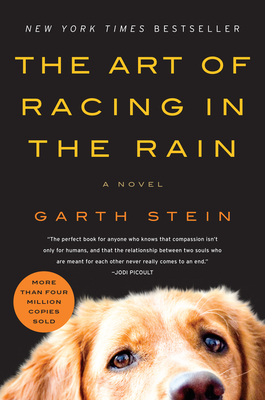
"One of the members organized the book club last year and we have been going strong since. We take turns hosting and the member who hosts chooses the book to read. We read all genres, mostly fiction. We have great discussions on all books but the The Art of Racing in the Rain by Garth Stein, and Handle With Care by Jodi Picoult were the best discussions.
Our name comes from the first book we read as a group - The Art of Racing in the Rain. We had a great discussion and decided that we would be called Enzo's Girls after the main character in the book."
I just love that the group's name came from a literary character in a book they read together. I've been in many reading groups, but not one of them ever had a name.
This book was also mentioned in Bring On The Tears, a recent Books on the Nightstand guest post by Josh Christie. Josh names this as one of the books that made him cry due to its "heartrending (yet hopeful) last few pages."
I have had this book on my nightstand for quite a long time. I may need to move it up higher.
Thank you, Kate, for telling us about your book group!
I got a book in the mail a few days ago and it has lived on my kitchen counter ever since. No, it's not there because it's a cookbook. It's there because I can't stop looking at it and the counter is the easiest, most accessible place to find it. More about the book in a moment, but first a little background.
I'm a LEGO fanatic. Always have been, always will be. I have wonderful memories of putting my LEGO Space sets together on the floor in front of the Christmas tree. (Buying my son his first LEGO set was a very happy day for me!) Also, having grown up in the 70's and 80's, Star Wars was a huge influence on me. I had all the action figures and saw the movies multiple times.
So imagine my thrill when I received LEGO Star Wars: The Visual Encyclopedia as a gift from a friend. LEGO first started releasing Star Wars sets in 1999. 190+ sets later, the line is celebrating its 10th Anniversary and this lavish book has been created to honor the occasion.
The book begins with a timeline of the sets, then goes into an in-depth look at each of them, with close-up photos, descriptions and facts and figures (the Millennium Falcon set has 5,195 pieces and a 311-page instruction manual!)
The book also includes an exclusive collectible LEGO minifigure of Luke Skywalker as he appeared at the end of the first Star Wars movie. Not only do you get an incredible book, but you get a toy too!
If you've got a Star Wars or LEGO fan in your life, you just found their holiday present.
___________________
We encourage you to write down or print out the title information and shop at your local bookstore. Titles link to LibraryThing, a social networking site that allows you to catalog your home library. LibraryThing also links to various online purchasing options. Here are the books from this post:
In segment one of this week's episode, we revisit the idea of "reading challenges," which we originally talked about in BOTNS podcast #4. Challenges are typically posted by a book blogger, who sets some rules and then "challenges" you to read a certain number of books, or books in a particular category, etc.
In Segment 2, we talk about dystopic young adult fiction. One of the most memorable books that Ann read as a kid was House of Stairs by William Sleator, which was dystopic, though Ann didn't know that term at the time. There are many books in this category that have been published recently, including The Hunger Games by Suzanne Collins and its sequel, Catching Fire. The Giver by Lois Lowry is a classic dystopic novel that won the Newbery Prize in 1994, and it's an incredibly powerful novel that adults will enjoy. Candor by Pam Bachorz has just been published, and was inspired by Celebration, Florida, the town that Disney built.
In segment 3, Michael talks about Peter and Max, a novel based on the bestselling Fables comic book series. It's the story of Peter Piper and his older brother Max, who live in the Black Forest and stumble upon some magic. Ann talks about The Maze Runner by James Dashner, a fantastic dystopic novel that had her wishing for a sequel as soon as she finished the book.
(You can listen by using the player at the top of this post. If you're using Internet Explorer, click twice to listen. If your browser does not support javascript, you won't see the player; click the link below the player to listen, or right-click to download the episode. If you are receiving this post by email and cannot see the player at the bottom of the message, please visit http://www.booksonthenightstand.com to listen)
_________________________
We encourage you to write down or print out the title information and shop at your local bookstore. Titles link to LibraryThing, a social networking site that allows you to catalog your home library. LibraryThing also links to various online purchasing options. Here are the books from this post:
House of Stairs by William Sleator, Puffin paperback The Hunger Games by Suzanne Collins, Scholastic hardcover Catching Fire by Suzanne Collins, Scholastic hardcover The Giver by Lois Lowry, Laurel-Leaf paperback Candor by Pam Bachorz, EgmontUSA Peter & Max by Bill Willingham and Steve Leialoha, Vertigo hardcover The Maze Runner by James Dashner, Delacorte Books for Young Readers hardcover
Welcome to DystopYA: the Books on the Nightstand reading challenge for Dystopic Young Adult fiction.
If you've read any of my posts or listened to our podcast lately, you know that I'm going through a 'dystopic fiction' phase. Some of the best books have been published as young adult novels. I find that they can stand side by side with the best adult fiction, and in many cases the stripped down language and precise writing fit the landscape of the book itself.
What is dystopic fiction? Wikipedia defines it as:
The utopia and its offshoot, the dystopia, are genres of literature that explore social and political structures. Utopian fiction is the creation of an ideal world, or utopia, as the setting for a novel. Dystopian fiction is the opposite: creation of a nightmare world, or dystopia. Many novels combine both, often as a metaphor for the different directions humanity can take in its choices, ending up with one of two possible futures. Both utopias and dystopias are commonly found in science fiction and other speculative fiction genres, and arguably are by definition a type of speculative fiction.
Suggested title list:
Here are some suggested titles in the category of Dystopic YA Fiction. These are books that we have read or that have been recommended to us by trusted booksellers. We talk about several of these books in Episode 47 of the Books on the Nightstand podcast.
There are always rules in dystopic societies. We will be benevolent despots in the running of this challenge. Your participation is voluntary and we will be deactivating the Reading Challenge Police, so you are on the honor system.
1. You must do as you are told. You are hereby commanded to read 3 works of dystopic fiction that were written or published primarily for young adults. A partial list of titles is above; you may choose other books that are not on this list. Books must be read between October 5, 2009 and December 31, 2009 in order to count for the challenge.
2. Secret activities are forbidden in dystopic societies. You must post your reading list and/or your review(s) of the books that you've read. Reviews can be formal or informal, as you like. You may post them one at a time or all at once, it's up to you. If you have a blog, please post there. If you do not have a blog, there are two options:
A. (Preferred) - use one of the special discussion threads we've set up on Facebook or Goodreads. Note: Facebook membership is required to post there, but anyone can read the messages. Goodreads requires you to be a member to post or read on the discussion board. Membership to both Facebook and Goodreads is free.
B. Post your reading list and/or reviews in the comments on this post.
3. A dystopic society controls the spread of information among its citizens. If you have teens or tweens in your life, tell them about this reading challenge, and consider doing it together.
4. Dystopic governments control your behavior with a system of rewards. So, there will be prizes!We'll do a random drawing from all participants at the end of the challenge.
5. Dystopic governments can track the identities of community members. Post the URL of your list/review in the Simply Linked box below. If you posted at Goodreads or Facebook, include the URL of the discussion post.
If you've chosen to post your list/review in the comments section below, you can still use the Simply Linked feature. Just type your name in the "Link Title" box followed by the word "comments" in parentheses, like this: Ann Kingman (comments) so that readers know that your reviews are at the end of this post. You can put anything in the in the URL box, it just can't be left blank.
This will give everyone an easy way to read your reviews, and will make the random drawing for the contest prize easier.
Need a button for your blog? Grab this one:
Our community begins on October 5, 2009. Will you be one of us?
(note: I just learned of another Dystopian YA Fiction Challenge over at Bart's Bookshelf. That meanst that you can knock off two challenges at the same time, though Bart's starts on October 15th. Go check out his challenge and sign up over there, too!)
Books on the Nightstand is the blog and podcast of Michael Kindness and Ann Kingman. We are friends and colleagues who work in the publishing industry. For more information and ways to get in touch with us, please see our About/Contact page.
Followers
Leave us a Voicemail
Have a comment, question, or book recommendation? Call our voicemail line and wait for the beep. Tell us if we may play your message on a future podcast.
(209) 867-READ (that's (209)867-7323)


 I think the idea of a book group within a museum or arts organization is an idea that should be more widespread. If you know of any others, please tell us in the comments. And if you work with an arts organization in your area, please consider hosting a book group of your own. I know that if there were such a group near me, I'd be sure to join!